haining.wang@insilicomedicine.com
https://doi.org/10.1038/s41467-025-65796-8
The core workflow encompasses a multi-parameter optimization (MPO) and molecular design framework that includes:
- 20+ AI generative models for the design of novel warhead scaffolds generation
- Druglike molecular property prediction through over 900 Medicinal Chemistry Filters (MCFs)
- Binding affinity prediction via Pocket-Ligand Interface (PLI) scoring with LE / LLE reference metrics for comprehensive candidate assessment and prioritization
- Early Kinome off-target screening with Golden Cubes
- Medicinal chemistry-guided refinement
- 140 built-in ADMET prediction models for concurrent pharmacokinetic property optimization
These considerations motivated us to explore a targeted protein degradation strategy for PKMYT1. A PROTAC approach could convert transient target binding into durable PKMYT1 depletion by recruiting an E3 ligase and inducing ubiquitin-proteasome-mediated degradation. In principle, this mechanism may provide deeper and longer-lasting pathway suppression than reversible inhibition alone. It may also improve functional selectivity by promoting productive ternary complex formation, in which the target protein, PROTAC, and the E3 ligase must form a geometrically compatible complex.
However, successful PKMYT1 PROTAC design depends critically on the quality of the warhead. The warhead must not only bind PKMYT1 with sufficient potency, but also provide an appropriate linker exit vector, maintain cellular permeability after conjugation, and avoid broad off-target kinase engagement. Therefore, instead of directly converting RP-6306 into a degrader, the project aimed to design a new PKMYT1 warhead better suited for PROTAC construction.
This rationale led to three major design requirements: improved kinase selectivity, a linker-accessible binding orientation, and a more PROTAC-compatible physicochemical profile.
For detailed target biology, synthetic lethality mechanisms, and the rationale for druggability, please refer to the published paper.
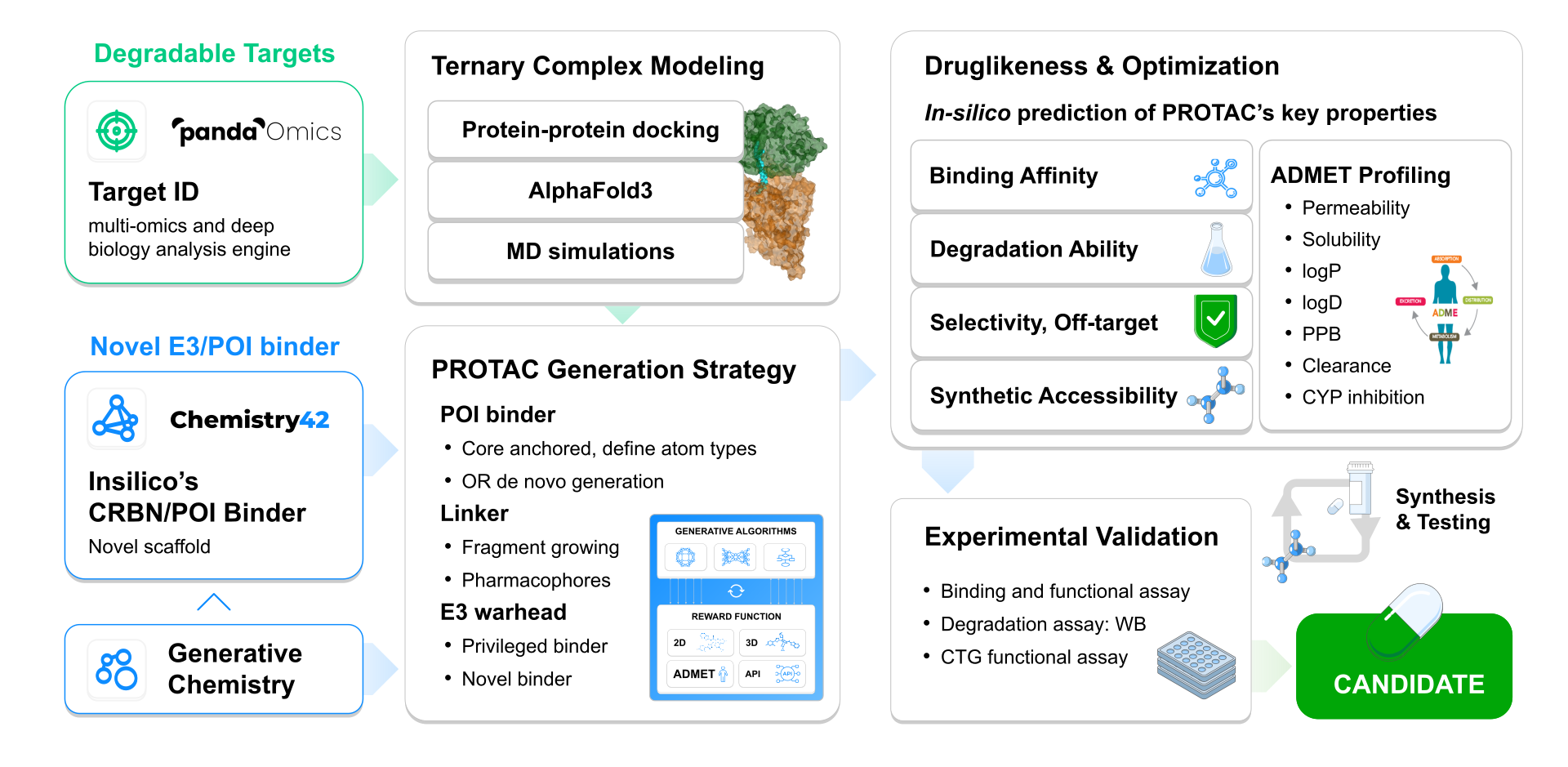
Figure 1.
Overview of the Chemistry42-driven end-to-end design workflow for the PKMYT1 PROTAC.
Phase 1: AI-Powered Warhead Generation and Selection
Meticulous Design Input Structure Preparation
Starting Ligand and Pharmacophore Setup: RP-6306 (8D6E) was used as a reference ligand. Explicit hydrogen-bond pharmacophore constraints were set around its key interactions with PKMYT1 in the hinge-binder region, defining two critical hydrogen bonds (one donor, one acceptor). A mandatory Point was applied to enforce these pharmacophore features as hard constraints, ensuring that all AI-generated scaffolds satisfy these key interactions: a prerequisite for maintaining high affinity to PKMYT1. Additionally, a 2D Privileged Fragment was used to fix the 2,4-dimethyl-3-phenol region, preserving this critical hydrophobic anchor in the back pocket. We deliberately removed the crystallographic water molecules from the region facing the solvent-exposed pocket, enabling Chemistry42 to freely grow fragments in this area and explore novel scaffolds that extend toward the solvent and provide attachment points for linkers.

Figure 2.
Chemistry42 warhead generation experiment initial setup interface: RP-6306 as input ligand, showing protein structure, pharmacophore constraints, and Mandatory Points configuration

Figure 3.
Chemistry42 pocket dilation (5 Å) setting interface.

Figure 4.
Chemistry42 pharmacophore-constraint detailed setup interface, showing precise definitions of the hinge-region hydrogen-bond donors and acceptors.
Note: Chemistry42 now supports Protein Pharmacophores, enabling users to set specific protein residues, such as Gln196, as direct pharmacophore constraints. This allows AI-generated models to explore the key interaction space without requiring a reference ligand structure.
Iterative Experimental Configuration and Chemistry42 Selection Strategy
Chemistry42 provides three preset AI generative model tiers to accommodate the needs of different stages:

Figure 5.
Chemistry42’s three preset AI generative model tiers: Light, Optimal, and Advanced.
Multi-Parameter Assessment
PLI Score (Pocket-Ligand Interaction Score) evaluates each generated molecule’s theoretical binding energy to the PKMYT1 binding pocket, serving as a first-pass filter to eliminate clearly non-binding compounds.
LE (Ligand Efficiency) and LLE (Lipophilic Ligand Efficiency) Reference Metrics. The thresholds of LE > 0.3 and LLE > 3 are not hard cutoff filters but serve as reference indicators to assist in prioritization.
The reference value of these two metrics reflects the core requirements of an ideal PROTAC warhead from complementary angles: LE reference: A high-quality warhead must not only exhibit strong affinity for the protein of interest (POI), but crucially the molecule must not be overly bulky, the number of heteroatoms should be minimized, and both hydrogen bond donors (HBDs) and acceptors (HBAs) should be kept to a reasonable count. This is because the warhead must ultimately be connected to a linker and E3 binder to form the complete PROTAC molecule; a compact warhead preserves precious molecular weight and polarity budget for the downstream modules. LLE reference: A reasonable LogP value is another critical warhead design consideration. High LLE indicates that molecular activity derives from specific polar interactions rather than non-specific hydrophobic contacts. This provides a wider physicochemical optimization window for subsequent overall PROTAC performance tuning, especially for the development of orally bioavailable PROTAC drugs.
Golden Cubes Rapid Kinase Screening
Golden Cubes is Chemistry42’s built-in kinase screening module, which rapidly provides virtual predictions of each generated molecule’s inhibitory potential against tens of kinases. The module operates as follows: for each kinase, it outputs a probability value representing the likelihood that the compound inhibits that kinase with an IC50 below 500 nM. A higher probability indicates a greater likelihood of the compound inhibiting that particular kinase. In the visualization interface, kinases with a high probability (i.e., high off-target risk) are marked with green cubes.
Screening criterion in this project: Molecules with 5 or fewer green cubes (i.e., 5 or fewer kinases predicted as likely off-targets) advanced to the next stage.

Figure 6.
Chemistry42 Golden Cubes kinase screening module visualization interface. Each cube represents a kinase; green cubes indicate a high probability that the compound will achieve an IC50 < 500 nM for that kinase (indicating a high off-target risk). Screening criterion: 5 or fewer green cubes.
User Manual Refinement (AI + Human Synergy)

Figure 7.
Warhead Compound 3 was obtained after manual modification involving the introduction of the CN group.
From Compound 3 to Final Warhead ISM4963
As such, the terminal carbon (methyl) at the solvent-exposed end of Compound 3 was replaced with an NH2 group, yielding the final warhead: ISM4963
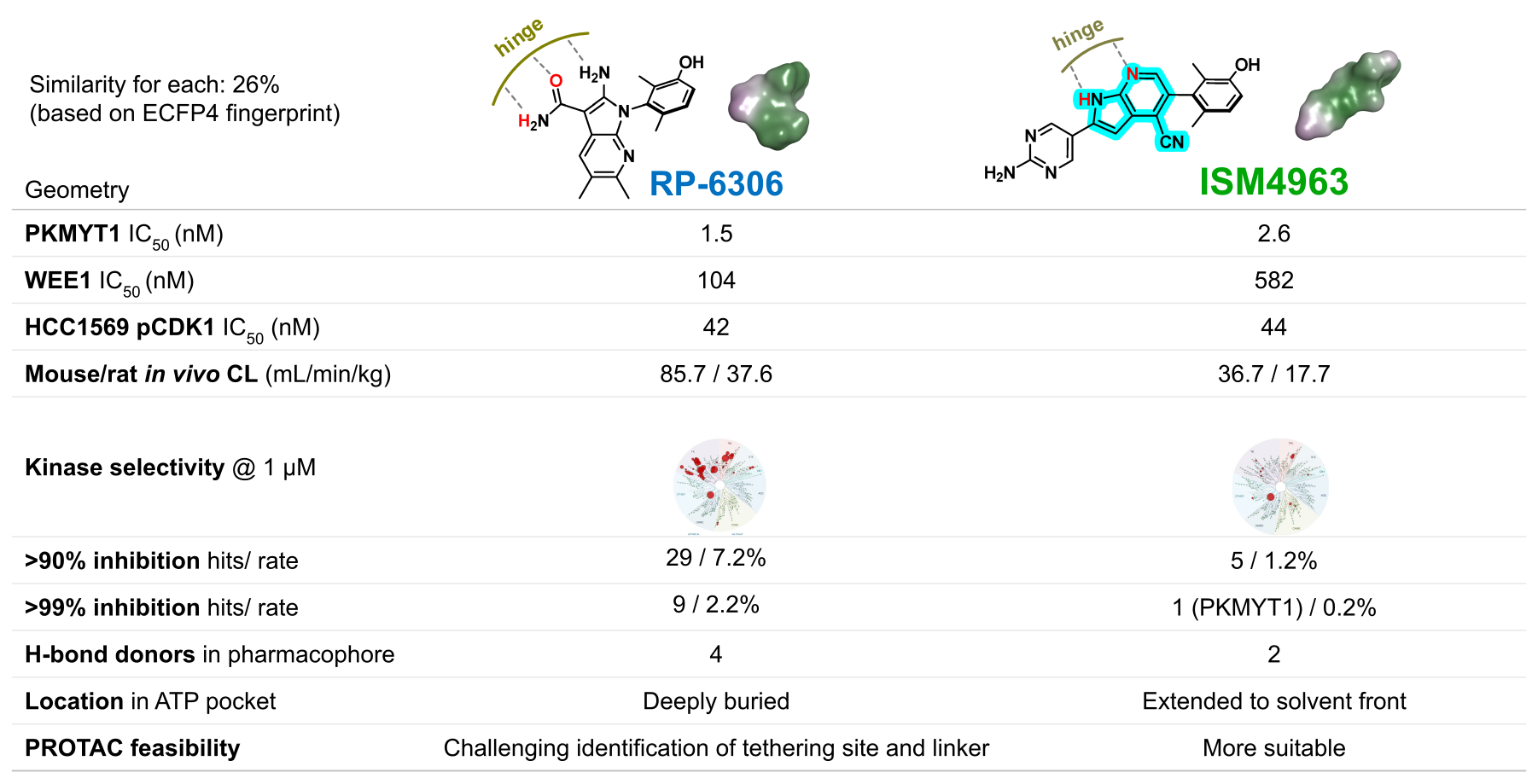
Figure 8.
A comparison of ISM4963 and RP-6306. ISM4963 achieves excellent kinase selectivity and pharmacokinetic properties while maintaining high affinity.
Phase 2: Ternary Complex Modelling and Spatial Constraint Extraction
E3 ligase and binder selection: CRBN was selected as the E3 ligase subunit for this project. The E3 binder was selected by medicinal chemists manually based on established structure-activity relationships for the pomalidomide series.
Ternary complex conformational modelling: External computational tools were first used to perform preliminary docking of the PKMYT1-CRBN complex, generating candidate conformations. These candidates were then imported into MD for full-atom molecular dynamics stability assessment, filtering out unstable docking poses, and ultimately selecting an optimal ternary complex model.
E2 subunit introduction and ubiquitination geometry assessment: Following MD stability screening and selection of the ternary complex conformation, the E2 ubiquitin-conjugating enzyme subunit was further introduced using existing experimental structure models or AlphaFold3 predictions to construct a complete PKMYT1-PROTAC-CRL4(CRBN)-E2 complex. This complete model was used to assess whether the target lysine on the PKMYT1 surface (Lys345) is oriented toward E2 in a geometry consistent with productive ubiquitination, a key modelling step for conformational prioritization. It should be noted that this Lys345 ubiquitination model remains a computational hypothesis proposed based on the structural model; experimental validation is still pending. Nevertheless, this structural assessment provides valuable rationale for selecting ternary complex poses most likely to support productive degradation.

Figure 9.
Schematic of the PKMYT1-PROTAC-CRL4(CRBN)-E2 complex model. PKMYT1 is shown in green, with Lys345 (green sticks) oriented toward the E2 ubiquitin-conjugating enzyme, satisfying the correct ubiquitination geometry. in a geometry consistent with productive ubiquitination (computational hypothesis; experimental validation pending)
Phase 3: AI-Designed Linkers
We employed Chemistry42’s Anchor Points to fix the two terminal binders (AI-designed ISM4963 + manually selected CRBN ligand) and deployed a multi-round linker generation strategy. Anchor Points are designated “locked atoms” in Chemistry42’s molecular editor at the two connection endpoints ( see blue spheres in Figure 10). The AI Models, therefore, do not alter the chemical structures at these two ends during generation and explore linker chemical space exclusively between the two Anchor Points.
Similar to the warhead design phase, linker design also required iterative exploration of different platform configurations. We tested multiple configuration schemes, including different constraint combinations, fragment-guidance strategies, and ADMET-optimization weights, progressively optimizing configurations through iterative feedback.

Figure 10.
Chemistry42 linker generation experiment setup interface. Both terminal binders are fixed via Anchor Points (red labels), with AI exploring linker structures only in the intervening region.
Round 1: Unconstrained Chemical Space Exploration
Key Discovery, Emergence of Piperazine Motif: Among the large number of linkers generated in this unconstrained exploration round, the platform autonomously “discovered” a class of linker structures containing a piperazine ring. Molecular docking analysis revealed that the piperazine nitrogen atoms formed novel hydrogen-bond interactions with protein residues in the linker region. This finding is significant: traditional PEG linkers are typically considered inert connectors, whereas the piperazine-containing linker actively participates in protein binding, providing an additional contribution to ternary complex stability.

Figure 11.
Schematic showing the novel hydrogen-bond interactions introduced by the piperazine motif in the linker region. The protonated nitrogen of the piperazine ring forms a hydrogen bond with PKMYT1 residue Leu116, actively participating in protein binding.
Round 2: MCS Privileged Fragment Guidance and Rigidification

Figure 12.
The privileged Fragments library is used in the Round 2 linker generation. These fragments were prepared by extracting Maximum Common Substructures (MCS) from public PROTAC linker compound libraries and used as 2D constraint conditions to guide AI generation.
Chemistry42’s built-in ADMET prediction models played a pivotal role at this stage. In conventional PROTAC development, ADMET optimization typically occurs late in the process, leading to high attrition rates due to poor drug-like properties. Chemistry42 front-loads ADMET prediction into the generative process, providing each AI-generated linker with concurrent multi-dimensional property assessments, including solubility, clearance, and permeability, enabling a “generate-and-optimize-simultaneously” workflow.
Breakthrough Modification – Spirocyclic Rigidification: The AI generative models successfully incorporated 5,6-spirocycle rigid structural motifs into the linker, yielding multiple benefits: Rigid structures reduce the number of flexible rotatable bonds, lowering conformational entropy penalties and improving oral absorption - Ether rings provide additional polar surface area, enhancing aqueous solubility - Achieved an optimal balance between rigidity and polarity, overcoming the traditional challenge of poor water solubility in large-molecule drugs.
Ultimately, spirocyclic linker variants achieved a >100-fold improvement in solubility (FeSSIF, Fasted State Simulated Intestinal Fluid) over flexible linkers (reaching 156 μM), with corresponding improvements in oral bioavailability.
Round 2: MCS Privileged Fragment Guidance and Rigidification
- Alchemistry: Performed relative binding free energy (RBFE) calculations on shortlisted candidates during the warhead optimization stage, where the compounds are conventional small molecules, and RBFE predictions are well-established and reliable. For PROTAC-sized molecules, however, the accuracy of RBFE calculations remains an area of active investigation; the Alchemistry results at the PROTAC stage were therefore used as directional guidance to complement, rather than replace, experimental affinity data. Further experimental work is needed to fully validate the accuracy of RBFE for macromolecular PROTACs.
- Retrosynthesis: Assessed the synthetic feasibility of generated molecules, ensuring that AI-designed structures possess reasonable synthetic routes and avoiding “computationally perfect but unsynthesizable” candidates.

Figure 13.
Overall structural schematic of the final candidate molecule ISM2286 (D16-M1P2), showing the three-module architecture of warhead (ISM4963), spirocyclic linker, and CRBN binder, along with key protein interactions.
The core value of Chemistry42 lies not only in the technical capability of individual modules but in integrating meticulous input configuration, iterative configuration optimization, AI generation, selectivity prediction, molecular dynamics simulation, and ADMET optimization into an end-to-end, controllable, and reproducible industrialized design loop. In the PROTAC field, this workflow paradigm organically combines drug discovery experts' structural insight and manual refinement, significantly reducing R&D uncertainty and accelerating the discovery of high-quality candidate molecules.
- Wang, Y., Wang, X., Liu, T. et al. Discovery of a bifunctional PKMYT1-targeting PROTAC empowered by AI-generation. Nature Communications 16, 10759 (2025).
- Gallo, D., Young, J. T. F., Fourtounis, J. et al. CCNE1 amplification is synthetic lethal with PKMYT1 kinase inhibition. Nature604, 749–756 (2022).
- Szychowski, J., Papp, R., Dietrich, E. et al. Discovery of an orally bioavailable and selective PKMYT1 inhibitor, RP-6306. Journal of Medicinal Chemistry 65, 10251–10284 (2022).
This white paper was prepared by Insilico Medicine. For further information about Chemistry42’s applications in targeted protein degradation, please contact us. info@insilico.com