HONG KONG — March 23, 2026 — Insilico Medicine (“Insilico”), a clinical-stage generative artificial intelligence (AI)-driven drug discovery company, today announced the launch of PandaClaw, a transformative new feature of the PandaOmics engine that combines AI agents with biological and bioinformatics workflows. By automating complex real-time analyses, the tool enables researchers to seamlessly discover novel targets, identify new indications, and build disease hypotheses through an intuitive, intelligent natural language interface, thereby accelerating translational medical research.
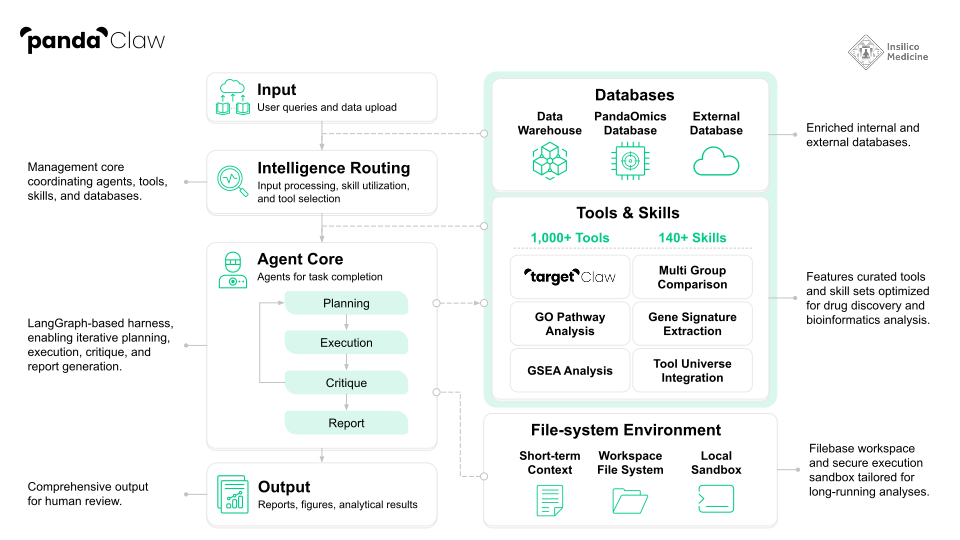
The traditional AI-enabled drug discovery landscape often requires “bilingual” professionals — experts fluent in both biomedicine and artificial intelligence—where training talents may take longer than developing the software itself. As foundation models and AI agent technologies mature, this gap can be bridged more effectively. PandaClaw lowers the barrier for biologists to apply AI, enabling sophisticated studies without specialized computational training. It addresses this need through three core components: an Agent Core modeled on the workflow-driven logic of experienced biologists, proprietary Data Warehouses curated by the cross-disciplinary expertise of data scientists and biologists, and a Skills library built on the analytical reasoning of veteran bioinformaticians.
PandaClaw operates through a seamless autonomous workflow powered by a cutting-edge agent architecture utilizing LangChain and LangGraph frameworks. When presented with a research objective, the Agent Core autonomously formulates a multi-step analytical workflow, parsing natural language requests into distinct tasks. Next, it aggregates and cross-references multi-omics datasets by drawing from native access to the PandaOmics platform, internal data warehouses, external biological databases, and proprietary user data. The system then executes these tasks by dynamically selecting the optimal resources from an expansive toolkit, which integrates over 140 specialized scientific skills and more than 1,000 bioinformatics tools. To ensure scientific integrity, the agent autonomously diagnoses and self-corrects formatting issues or data anomalies within an isolated local sandbox. Finally, the platform produces high-quality, figure-rich reports while maintaining strict data provenance and scientific transparency.
PandaClaw operates through a seamless autonomous workflow powered by a cutting-edge agent architecture utilizing LangChain and LangGraph frameworks. When presented with a research objective, the Agent Core autonomously formulates a multi-step analytical workflow, parsing natural language requests into distinct tasks. Next, it aggregates and cross-references multi-omics datasets by drawing from native access to the PandaOmics platform, internal data warehouses, external biological databases, and proprietary user data. The system then executes these tasks by dynamically selecting the optimal resources from an expansive toolkit, which integrates over 140 specialized scientific skills and more than 1,000 bioinformatics tools. To ensure scientific integrity, the agent autonomously diagnoses and self-corrects formatting issues or data anomalies within an isolated local sandbox. Finally, the platform produces high-quality, figure-rich reports while maintaining strict data provenance and scientific transparency.
“PandaClaw is far more than a sophisticated search engine; it is a comprehensive autonomous agent designed to mirror the logic and expertise of seasoned biologists and bioinformaticians,” said Dr. Frank Pun, Head of Insilico Medicine Hong Kong. “While our foundational PandaOmics platform has long provided industry-leading quantitative results in target rankings and indication prioritization, PandaClaw transcends these capabilities by delivering qualitative real-time multi-omics analyses with in-depth data interpretations. These insights are reinforced by robust statistical validation and deep biological annotation, contextualizing findings to provide researchers with a level of clarity previously unavailable in automated systems.”
The launch of PandaClaw also stands as the latest milestone in Insilico’s journey toward pharmaceutical superintelligence. Within PandaOmics, this evolution began in March 2023 with ChatPandaGPT, which enabled natural language interaction with literature and knowledge graphs. It progressed in July 2024 with Ask Panda, an internal release that allowed users to query Target ID results within the platform. Now, in March 2026, PandaClaw emerges as a fully realized biological analysis agent. Capable of executing complex tasks, bridging computational results with mechanistic interpretation, and delivering real-time results via simple natural language commands, PandaClaw represents the new standard in autonomous, accessible, and expert-level therapeutic discovery.
Harnessing state-of-the-art AI and automation technologies, Insilico has significantly improved the efficiency of preclinical drug development, setting a benchmark for AI-driven drug R&D. While traditional early-stage drug discovery typically requires an average of 4.5 years, Insilico has nominated 20 preclinical candidates from 2021 to 2024, with an average timeline—from project initiation to preclinical candidate (PCC) nomination—of just 12 to 18 months per program, with only 60 to 200 molecules synthesized and tested in each program.
The launch of PandaClaw also stands as the latest milestone in Insilico’s journey toward pharmaceutical superintelligence. Within PandaOmics, this evolution began in March 2023 with ChatPandaGPT, which enabled natural language interaction with literature and knowledge graphs. It progressed in July 2024 with Ask Panda, an internal release that allowed users to query Target ID results within the platform. Now, in March 2026, PandaClaw emerges as a fully realized biological analysis agent. Capable of executing complex tasks, bridging computational results with mechanistic interpretation, and delivering real-time results via simple natural language commands, PandaClaw represents the new standard in autonomous, accessible, and expert-level therapeutic discovery.
Harnessing state-of-the-art AI and automation technologies, Insilico has significantly improved the efficiency of preclinical drug development, setting a benchmark for AI-driven drug R&D. While traditional early-stage drug discovery typically requires an average of 4.5 years, Insilico has nominated 20 preclinical candidates from 2021 to 2024, with an average timeline—from project initiation to preclinical candidate (PCC) nomination—of just 12 to 18 months per program, with only 60 to 200 molecules synthesized and tested in each program.