Presentations include first-in-human Phase 1 results in healthy volunteers, 13-week repeat-dose toxicology in two species, and disease mitigation in a chronic T cell transfer-induced colitis model
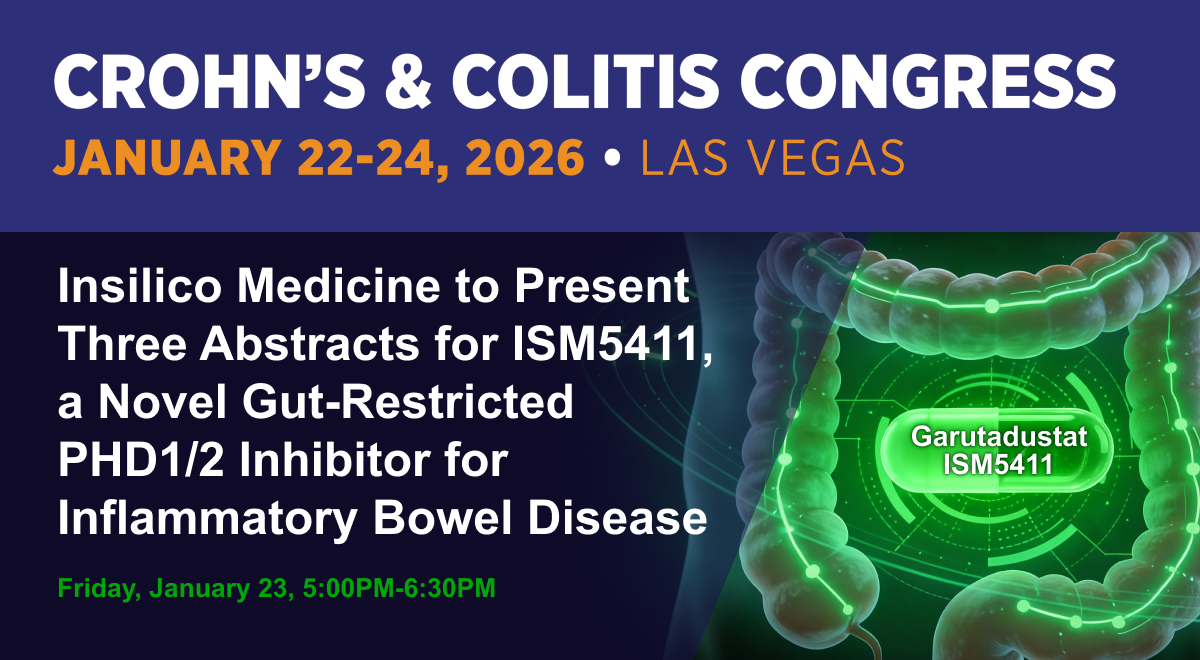
CAMBRIDGE, Mass. and SHANGHAI — January 22, 2026 — Insilico Medicine (“Insilico”, HKEX: 03696), a clinical-stage AI-driven biotechnology company, today announced it will present three abstracts at the 2026 Crohn’s & Colitis Congress 2026 in Las Vegas, USA on January 23, 2026 featuring new data supporting the continued development of ISM5411 (also referenced as ISM012-042), an orally administered, gut-restricted small-molecule inhibitor of prolyl hydroxylase domain proteins 1/2 (PHD1/2) for inflammatory bowel disease (IBD).
ISM5411 is designed to stabilize hypoxia-inducible factor (HIF)-1α locally in the gastrointestinal tract, promoting expression of genes protective of the intestinal mucosa and supporting maintenance and repair of mucosal integrity with the goal of reducing inflammation while limiting systemic exposure.
“These data reinforce ISM5411 as a novel, AI-driven approach to inflammatory bowel disease that targets both epithelial integrity and inflammatory pathways involved in mucosal healing,” said Carol Satler, Senior V.P. of Clinical Development at Insilico Medicine. “By reinforcing gut barrier integrity while regulating inflammation, we believe this mechanism is well suited to support both induction and long-term maintenance in IBD treatment without systemic liabilities.”
Featured data at 2026 Crohn’s & Colitis Congress
1) First-in-human Phase 1 (Australia): safety, tolerability, and pharmacokinetics consistent with gut restriction
Presentation: Poster Hall Reception | Poster #: P029 | Date/Time: Friday January 23, 2026 5:00PM-6:30PM|
Insilico will present results from a randomized, double-blind, placebo-controlled Phase 1 study in healthy subjects conducted at a single site in Australia (NCT06012578), evaluating single ascending doses (50–1000 mg) and multiple ascending doses (200, 400, 800 mg once daily for 14 days).
Key findings reported in the abstract include:
2) 13-week repeat-dose toxicology (rats and dogs): favorable profile and NOAEL at highest dose tested
Presentation: Poster Hall Reception | Poster #: P145 | Date/Time: Friday January 23, 2026 5:00PM-6:30PM|
A second abstract reports results from 13-week repeat-dose oral toxicology studies in Sprague-Dawley rats (0, 100, 300, 1000 mg/kg/day) and Beagle dogs (0, 25, 80, 1000 mg/kg/day), each followed by a 28-day recovery period.
Key findings reported in the abstract include:
3) Chronic T cell transfer-induced colitis model: preventive and therapeutic mitigation, including with anti-TNF
Presentation: Poster Hall Reception | Poster #: P147 | Date/Time: Friday January 23, 2026 5:00PM-6:30PM|
A third abstract evaluates ISM012-042 (ISM5411) in a chronic T cell transfer-induced colitis mouse model, using both preventive (days 0–42 post-colitis induction) and therapeutic (days 21–42) dosing paradigms, alone and in combination with anti-TNF-α.
Key findings reported in the abstract include:
Abstract titles (as submitted)
By integrating advanced AI and automation technologies, Insilico has significantly improved the efficiency of early-stage drug development in real-world practices, setting a benchmark for AI-driven drug discovery. Whereas traditional early-stage drug discovery typically requires 2.5 to 4 years, more than 20+ of Insilico’s internal programs initiated between 2021 and 2024 achieved PCC nomination in just 12 to 18 months on average, with only about 60–200 molecules synthesized and tested per program.
CAMBRIDGE, Mass. and SHANGHAI — January 22, 2026 — Insilico Medicine (“Insilico”, HKEX: 03696), a clinical-stage AI-driven biotechnology company, today announced it will present three abstracts at the 2026 Crohn’s & Colitis Congress 2026 in Las Vegas, USA on January 23, 2026 featuring new data supporting the continued development of ISM5411 (also referenced as ISM012-042), an orally administered, gut-restricted small-molecule inhibitor of prolyl hydroxylase domain proteins 1/2 (PHD1/2) for inflammatory bowel disease (IBD).
ISM5411 is designed to stabilize hypoxia-inducible factor (HIF)-1α locally in the gastrointestinal tract, promoting expression of genes protective of the intestinal mucosa and supporting maintenance and repair of mucosal integrity with the goal of reducing inflammation while limiting systemic exposure.
“These data reinforce ISM5411 as a novel, AI-driven approach to inflammatory bowel disease that targets both epithelial integrity and inflammatory pathways involved in mucosal healing,” said Carol Satler, Senior V.P. of Clinical Development at Insilico Medicine. “By reinforcing gut barrier integrity while regulating inflammation, we believe this mechanism is well suited to support both induction and long-term maintenance in IBD treatment without systemic liabilities.”
Featured data at 2026 Crohn’s & Colitis Congress
1) First-in-human Phase 1 (Australia): safety, tolerability, and pharmacokinetics consistent with gut restriction
Presentation: Poster Hall Reception | Poster #: P029 | Date/Time: Friday January 23, 2026 5:00PM-6:30PM|
Insilico will present results from a randomized, double-blind, placebo-controlled Phase 1 study in healthy subjects conducted at a single site in Australia (NCT06012578), evaluating single ascending doses (50–1000 mg) and multiple ascending doses (200, 400, 800 mg once daily for 14 days).
Key findings reported in the abstract include:
- 76 subjects dosed; no serious adverse events (SAEs) or deaths reported at any dose
- One discontinuation due to a grade 1 rectal hemorrhage, judged not related to ISM5411
- Treatment-emergent adverse event (TEAE) incidence: 25.0% for ISM5411 pooled cohort vs 55.0% for placebo; all TEAEs in ISM5411 cohorts were Grade 1
- Pharmacokinetics: Oral ISM5411 resulted in very low plasma exposure and >30% excreted in feces in prototypic form, supporting a gut-restricted profile.
- Biomarkers: Post-dose erythropoietin (EPO) changes largely within or near normal range; no clear trend observed in systemic VEGF across cohorts; both support a gut-restricted profile with minimal expression of systemic HIF-1α stabilization biomarkers.
2) 13-week repeat-dose toxicology (rats and dogs): favorable profile and NOAEL at highest dose tested
Presentation: Poster Hall Reception | Poster #: P145 | Date/Time: Friday January 23, 2026 5:00PM-6:30PM|
A second abstract reports results from 13-week repeat-dose oral toxicology studies in Sprague-Dawley rats (0, 100, 300, 1000 mg/kg/day) and Beagle dogs (0, 25, 80, 1000 mg/kg/day), each followed by a 28-day recovery period.
Key findings reported in the abstract include:
- ISM5411 was well tolerated in both species, with no test article-related adverse findings.
- Findings were limited to moderate, reversible increases in erythroid parameters in dogs (≤+30.34% in RBC count, hemoglobin, hematocrit), which fully resolved after recovery and were not considered adverse based on lack of associated pathology/histopathology.
- ISM5411 demonstrates approximately 100-fold higher exposure in colon tissue versus plasma across preclinical species, supporting a gut-restricted, localized pharmacology profile with minimal systemic exposure.
- No observed adverse effect level (NOAEL): 1000 mg/kg/day in both species, supporting clinical advancement and informing dose selection and safety monitoring.
3) Chronic T cell transfer-induced colitis model: preventive and therapeutic mitigation, including with anti-TNF
Presentation: Poster Hall Reception | Poster #: P147 | Date/Time: Friday January 23, 2026 5:00PM-6:30PM|
A third abstract evaluates ISM012-042 (ISM5411) in a chronic T cell transfer-induced colitis mouse model, using both preventive (days 0–42 post-colitis induction) and therapeutic (days 21–42) dosing paradigms, alone and in combination with anti-TNF-α.
Key findings reported in the abstract include:
- Preventive ISM012-042 (10 or 30 mpk, PO QD) or anti-TNF-α reduced disease severity across endpoints including body weight loss, disease activity index (DAI), and colon morphology, and reduced inflammatory mucosal cytokines such as IFN-γ, TNF-α, and IL-6, along with decreases in inflammatory T cell subsets in mesenteric lymph nodes.
- Histology showed less crypt damage, inflammatory infiltration, and fibrosis with administration of ISM012-042 (ISM5411) with and without anti-TNF-α.
- Therapeutic dosing post-induction (and combination with anti-TNF-α) reduced DAI, colon density, and mucosal cytokines including IL-6, IFN-γ, TNF-α, and IL-17A.
Abstract titles (as submitted)
- ISM5411, a novel gut-restricted PHD1/2 inhibitor for inflammatory bowel disease: a randomized, double-blind, placebo-controlled, first-in-human Phase I study to evaluate safety, tolerability and PK profiles
- Preclinical Toxicology Evaluation of ISM5411: 13-Week Oral Administration in Rats and Beagle Dogs
- ISM012-042 (ISM5411), a PHD1/2 inhibitor, preventatively and therapeutically mitigates T cell transfer-induced colitis in mice
By integrating advanced AI and automation technologies, Insilico has significantly improved the efficiency of early-stage drug development in real-world practices, setting a benchmark for AI-driven drug discovery. Whereas traditional early-stage drug discovery typically requires 2.5 to 4 years, more than 20+ of Insilico’s internal programs initiated between 2021 and 2024 achieved PCC nomination in just 12 to 18 months on average, with only about 60–200 molecules synthesized and tested per program.